

It’s long been considered important to balance your sympathetic and parasympathetic nervous system, but in reality, most athletes don’t even try. Ian Craig explores this complex topic, which has some simple take homes.
In 2014 (1), I wrote an article on the hypothalamus-pituitary-adrenal (HPA) axis, primarily focussing on the regulation and support of the endocrine system. It’s now the turn of the nervous system for deeper scrutiny. With this article, it is my intention to give you a physiological reminder of the functions and activities of the autonomic nervous system (ANS) to explain how it interacts with and influences endocrine and immune function and with health, physical performance and longevity in mind, provide you with some practical suggestions of how to keep this vital system well balanced in our daily hectic lives.
Autonomic, in a sense, stands for involuntary, although even that meaning has been challenged by some scientists. It’s involved in regulating vital functions such as temperature, blood pressure, heart rate and contractility, and hormonal output, processes that, in most cases, we have no voluntary control over. There are two major sub-divisions of the autonomic nervous system: the noradrenaline-secreting sympathetic nervous system (SNS), which has been labelled as ‘fight or flight’ and the acetylcholine (ACh) secreting parasympathetic nervous system (PNS), which has been labelled as ‘relax and repair’ or ‘rest and digest’.
Represented in this way, from a Chinese medicine perspective, the sympathetic nervous system and parasympathetic nervous system represent the concept of yin-yang very nicely: when we want something done, the sympathetic nervous system is intense and stimulating, and when we need to recover, the parasympathetic nervous system takes control of the situation. In reality, however, like most things physiological, the autonomic nervous system isn’t quite that simple. Scientists have found that instead of assuming this normal sympathetic/parasympathetic nervous system yin-yang balance, we need to be very function-specific in our understanding. I’ll give a few examples (2):
-
- The adrenal medulla (secretes adrenaline and noradrenaline) and most blood vessels only receive sympathetic nervous system innervation.
-
- The parasympathetic nervous system only innervates the sublingual glands (secretes saliva in the mouth).
-
- The male sex organs require the parasympathetic nervous system to obtain an erection, while they rely on the sympathetic nervous system for ejaculation.
-
- Heart rate and contractility are increased by the sympathetic nervous system but decreased by the parasympathetic nervous system.
-
- Intestinal motility is decreased by the sympathetic nervous system and increased by the parasympathetic nervous system.

As you can see from my list of examples plus Figure 1, sometimes the sympathetic nervous system and parasympathetic nervous system help each other; sometimes, they oppose each other, and at other times, they act independently. Cohen & Sherman (2) term this relationship between the two divisions of the autonomic nervous system ‘cooperative integrative action’.
Hypothalamus – the juncture between the nervous system and endocrine system
In terms of autonomic nervous function, the hypothalamus is considered by physiologists as the major conduit for nerve pathways between the brain and the body. Of course, other brain centres are involved in certain processes (e.g. respiration), but the hypothalamus deserves some serious air time. You should also be aware that the hypothalamus is often considered the ‘master gland’ in endocrine function (1). So, although the nervous and endocrine systems are usually considered separately, the proximity of hypothalamic nerves to the autonomic nervous system means that hormone outputs of the hypothalamus coordinate closely with the activities of the sympathetic and parasympathetic nervous systems.
For example, corticotropin-releasing hormone (CRH), in addition to being a hormone releaser that activates adrenal hormone output, is also now considered as a neurotransmitter (3). It stimulates sympathetic nervous output from the brain and spinal cord while concurrently inhibiting the parasympathetic nervous system, activating a stimulating action via both endocrine and nervous systems.
The immune system as a communication network
According to old-school physiology (2), the autonomic nervous system influences the immune system in two ways:
-
- CRF from the hypothalamus stimulates the release of ACTH (adrenocorticotropic hormone) from the pituitary, which activates the adrenal output of cortisol, which has an immune-modulating effect. Physiological cortisol levels support immunity, whereas long-term elevation of stress hormones will likely suppress the immune system (4).
-
- The thymus, spleen, lymph nodes, bone marrow and vasculature are all innervated by nerves and, therefore, influenced by the outputs of the autonomic nervous system.
But we now know that the interaction of the nervous and immune systems is a lot more complex than presented. For example, the observation that receptor sites for neuropeptides exist on the surface of white blood cells (5 – Chopra or Pert) suggests realistically that our thoughts and emotions directly affect our immune strength. Additionally, studies have illustrated that the degree of tone of the sympathetic nervous system, via several mechanisms, is closely correlated with the levels of inflammatory cytokines, such as interleukin-1, interleukin-6 and tumour necrosis factor (6).
If you take a look at Figure 2, parasympathetic (vagal) nerves plus sensory fibres act as detectors of local inflammation, which, if the stimulus is strong enough, will give feedback to the central nervous system (CNS), resulting in a sympathetic nervous system response, with a net anti-inflammatory action. Overall, however, we cannot classify the sympathetic nervous system and the noradrenaline that it secretes as pro- or anti-inflammatory. According to Pongratz and Straub (6), “noradrenaline modulates immune function in a context-dependent manner.”
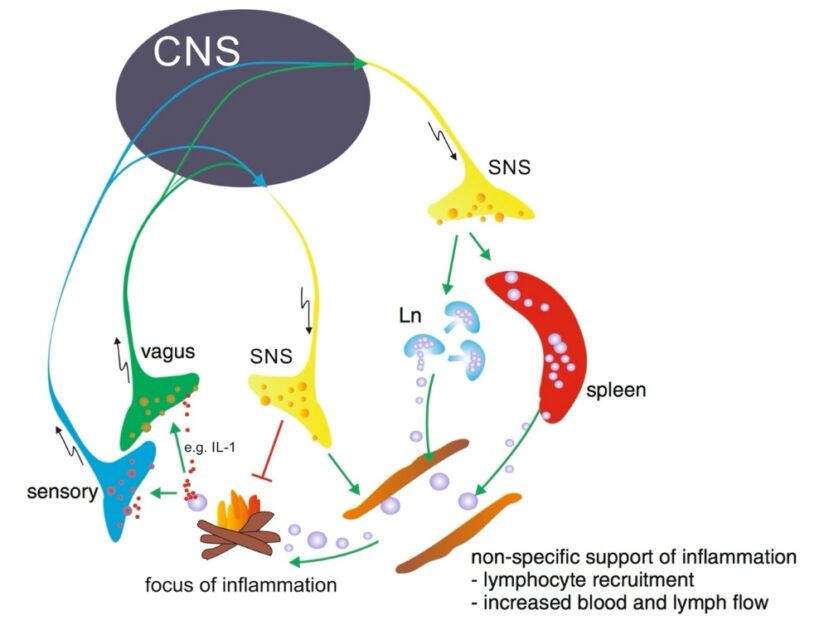
If we take rheumatoid arthritis (RA) as a model, in general, rheumatoid arthritis patients have an autonomic imbalance with an overly active sympathetic nervous system and reduced parasympathetic nervous system activity (7) and in line with this observation, it has been suggested that stress may aggravate disease activity. Interestingly, experimental stimulation of the vagus nerve has shown beneficial effects in rheumatoid arthritis patients.
Why would we consider a disease state such as rheumatoid arthritis in a sports nutrition magazine? Simply because it is a model of a stress state, just like we experience during heavy training. The effect of the training stress state has been beautifully illustrated by a nine-month longitudinal study of seven Italian national rowers following a periodised training regime towards the Junior World Rowing Championships.
Iellamo et al (8) noted that in healthy young subjects, there is consistent evidence that parasympathetic activity increases with fitness levels, but they wanted to see what happened in world-class athletes during strenuous training. They measured their athletes a total of four times at 3-monthly intervals; the first just after time off from the previous season, the middle two when they were at approximately 75 per cent of maximum training load, and the last measurement was taken during their peak training load, 20 days before the World Championships.
To assess sympathetic and parasympathetic balance, they measured heart rate variability (HRV). As expected, fitness levels (Peak VO2) increased from 5600 ml to 5800 ml during the nine months of the study. Their resting heart rate (RHR) decreased progressively, and their heart rate variability increased progressively from measurement sessions 1 to 3, meaning a shift towards parasympathetic dominance. However, by the time they reached their final measurement (at peak training load), they experienced a marked increase in RHR and a decrease in heart rate variability, indicating a shift into sympathetic dominance. Since this study, heart rate variability has been demonstrated as a potential early indicator of overtraining syndrome (e.g. 9,10).
It has, therefore, been observed that heavy training can shift an athlete into a sympathetic dominant state. It has also been also been observed that, in clinical settings, an imbalance between sympathetic and parasympathetic tone can increase systemic inflammation. These observations fit in with the study of cytokine sickness, an over-production and/or intolerance to interleukin-6 and other cytokines, which is thought to influence under-performance syndrome (UPS), another name for overtraining syndrome (11). This suggestion has been supported by Robson-Ansley et al (12), who noted that an acute period of intensified training can suppress the innate immune system and chronically increase IL-6 levels. These elevated cytokines can, in turn, increase fatigue and malaise, which are related to the cytokine theories of UPS.
The human body, particularly when you introduce the dynamics of stress and heavy training, is complex. But these central integrated functions, which collectively in nutritional therapy and functional medicine have become known as the communication systems, seem to go around in circles and heavily influence one another. I must admit that stepping into these detailed immune-central nervous system research papers stretched my mind because I struggled to find concrete physiological rules to pin my discussions around. However, stepping back and reading enough research from a variety of subject fields has brought us to this: The hypothalamus gland is indeed an excellent starting point for the understanding of these communication systems because of the obvious neural-endocrine integration that it represents, plus the body conductor role that it so eloquently plays.
It receives neural feedback from our body, information it uses to conduct sympathetic/parasympathetic nervous system and HPA outflow, which heavily influences the endocrine, immune and inflammatory activities. From an autonomic nervous system point of view, we can’t say that the sympathetic nervous system is stimulatory and the parasympathetic nervous system is relaxing; it’s not that simple. But, what we can say is that most of the time, we want the systems to be in relative balance, and when they are out of balance, it should be only for a short period of time. But to truly understand our body systems, we need to step up to a higher level in the brain and study some stuff that is complex on the one hand but incredibly simple on the other.
Higher centres and allostatic control
Although we may consider the hypothalamus a central focus in the nervous and endocrine systems, anatomically, it is near the base of the brain and from a traditional hierarchical point of view, perhaps it has some big brothers. This thinking leads us into the realms of psychoneuroimmunology, psychoneuroendocrinology and psychoneuroendoimmunology, research fields that were introduced to us by Dr Alex Concorde (13) in FSN, which reach beyond our nerves and into the grey matter of the higher brain centres, plus our spirit beyond. To simplify, the hypothalamus conducts our body processes fluently, but it has to answer to higher centres – our unconscious mind and our conscious mind. In effect, it is like a bridge between our mind and body.
According to psychobiologist Dr Philip Hayes (14), we transduct the energy of mental experience in our mind into the energy of physiological signs and symptoms in our body in our limbic-hypothalamus system. His example is of anger being transduced into myocardial contraction and the production of stress hormones. The limbic system is the oldest part of our cortex and has historically been labelled as the mediation of emotional behaviour, with a flow of information into the hypothalamus (2).
Additionally, nerves from the prefrontal cortex (used for logic, planning and organisation) project to the limbic system and hypothalamus, meaning that our hypothalamus, and therefore body, receive their inputs from areas of logical AND emotional thought. If it were left to our hypothalamus to make the final decisions, we would simply slow down when our physiology was overworked, such as in an over-training scenario. However, our conscious and unconscious minds, and don’t forget spirit, are shaped by years of psychological conditioning; why else do some people train themselves to the bone while others are bone idols? In both scenarios, the higher centres are overriding/overlooking the physiological messages returning to the hypothalamus.
Autonomic nervous system re-conditioning
Because we are talking about enthusiastic athletes here, we’ll stick with the over-training, as opposed to the under-training scenario. How do we give them daily tools to modulate the activities of the autonomic nervous system and, therefore, all the physiological functions it influences, such as endocrine, immune and inflammatory imbalances? After all, if we can merely reduce post-exercise inflammation by introducing some daily behaviours, we can potentially speed up recovery, as hinted by Robson-Ansley et al (12).
According to our rowing scientists (8), even in top-level athletes, sub-maximal exercise training enhances the vagal tone and decreases sympathetic cardiac stimulation. So most exercise is good for balance but to a point. I have three considerations to make with regard to autonomic nervous system balance: The first is that it helps if you can measure your sympathetic nervous system and parasympathetic nervous system activity. Heart rate variability is now a widely available technology; it is criticised by some scientists as unreliable, but when you talk to practitioners using the devices, it tallies well with what state they perceive the athlete to be in. In this regard, if you back up technology with perceptional observation (either that of the athlete or coach), it can be particularly helpful within a training programme.
Secondly, sleep is the ultimate parasympathetic stimulator, which is often compromised due to athletes trying to fit training sessions into already compacted days. Sleep quality is also vital. Thirdly, excessive systemic inflammation can be an aspect of sympathetic/parasympathetic nervous system imbalance: in addition to knowing what anti-inflammatory herbs and oils to use, an athlete’s diet needs to focus on micro and phytonutrient density and not just the big macronutrients. Sugars and refined carbs and oils, plus excessive saturated products from dairy products and meats, can accelerate a pro-inflammatory flame that has already been initiated by the physiological stresses of hard training.
My final point is that of training balance. As an endurance coach, my modern thinking is determining how an athlete can perform at their best with the least training. Also, including restorative training, such as flowing yoga or Tai Chi, is not, in my mind, optional. For example, Streeter et al (15) proposed a theory that the decreased parasympathetic nervous system and GABAergic activity that underlies stress-related disorders can be corrected by yoga practices. This thinking can also be applied to heavy training being a stress-related disorder: yoga or Tai Chi serves as an active restorative process that allows the active body to spend more hours of the day in a parasympathetic state.
- Craig I (2014). The Hypothalamus-Pituitary Axis. Functional Sports Nutrition. Jan-Feb 2014.
- Cohen DH & Sherman SM (1988). The Nervous System. In: Physiology. Ed: Berne RM & Levy MN. 2nd Edition. C.V. Mosby Company.
- Pacak K (2000). Stressor-specific activation of the hypothalamic-pituitary-adrenocortical axis. Physiol Res. 49(Suppl 1):S11-S17.
- Jefferies WM (1991). Cortisol and immunity. Med Hypotheses. 34(3):198-208.
- Pert C (1999). Molecules Of Emotion: Why You Feel The Way You Feel. Simon & Schuster.
- Pongratz G and Straub RH (2014). The sympathetic nervous response in inflammation. Arthritis Research & Therapy. 16:504.
- Koopman FA et al (2011). Restoring the balance of the autonomic nervous system as an innovative approach to the treatment of rheumatoid arthritis. Mol Med. 17(9-10):937-948.
- Iellamo et al (2002). Conversion from vagal to sympathetic predominance with strenuous training in high-performance world class Circulation. 105:2719-2724.
- Kiviniemi AM et al (2014). Altered relationship between R-R interval and R-R interval variability in endurance athletes with overtraining syndrome. Scand J Med Sci Sports. 24(2):e77-e85.
- Baumert M et al (2006). Heart rate variability, blood pressure variability, and baroreflex sensitivity in overtrained athletes. Clin J Sport Med. 16(5):412-417.
- Robson P (2003). Elucidating the unexplained underperformance syndrome in endurance athletes: the interleukin-6 hypothesis. Sports Med. 33(10):771-781.
- Robson-Ansley PJ et al (2007). Elevated plasma interleukin-6 levels in trained male triathletes following an acute period of intense interval training. Eur J Appl Physiol. 99(4):353-360.
- Concorde A (2014). Psychoneuroendoimmunology: the holy grail of performance gain in sports. Functional Sports Nutrition. July/Aug 2014.
- Hayes P (2002). The psychobiology of stress and healing. Part 1 (of 3): A framework for modern stress. Stress News. (14)2.
- Streeter CC et al (2012). Effects of yoga on the autonomic nervous system, gamma-aminobutyric-acid, and allostasis in epilepsy, depression, and post-traumatic stress disorder. Med Hypotheses. 78(5):571-579.
 Ian Craig MSc DipCNE BANT Fellow INLPTA is the founder of the Centre for Integrative Sports Nutrition (CISN) and course leader of their online postgraduate level courses. He is an experienced exercise physiologist, nutritional therapist, NLP practitioner, and an endurance coach. Clinically, within a team dynamic, Ian works with sporting individuals and complex health cases at his Scottish home, and online. Additionally, Ian co-authored the Struik Lifestyle book Wholesome Nutrition with his natural chef wife Rachel Jesson, and is currently co-writing the Textbook of Integrative Sports Nutrition, to be published in 2025.
Twitter: @ian_nutrition