


By Ian Craig. Behaviour change in exercise or nutrition will never occur unless we can get into the mind of our clients; in a good way of course… In this personal reflection, nutritional therapist Ian Craig shares what 30 years of practice has taught him about mind-body work within sport and exercise nutrition, and about facilitating behaviour change in his clients.
Megan was one of the most frustrating clients I’d ever worked with. She’d have ‘good’ weeks, when she ate well and stuck to the agreed exercise plan, and ‘bad’ weeks when the proverbial s**t hit the fan at work and the wheels fell off her best efforts towards health. Her weight fluctuated in resonance with her lifestyle, and she was close to quitting our sessions. But around this time I attended mind-body training for sport and exercise nutrition, which included a goal setting technique called a ‘Well Formed Outcome’. Megan was my first client.
Instead of the usual 10 or 15 minutes of agreeing a goal with a client, I now spent a whole hour challenging Megan mentally, and helping her to set up a goal that truly aligned with her core values. The results were astounding – by shifting her focus away from her superficial desire to lose a few pounds and towards health outcomes that mattered deeply to her and her family, she transformed into a model client, regaining full control of her health, also improving her body composition in the process!
Behaviour Change in Nutrition and Exercise: Why Advice Alone Rarely Works
 No matter how good or experienced a practitioner we are, we will ‘win’ some and ‘lose’ some cases. Some of our clients are simply not ready for our words of wisdom, yet. For those who potentially are ready, I use an analogy of a cliff edge to describe this readiness for behaviour change, which echoes the well-established idea that people move through stages of readiness. Some individuals are already standing right at the edge and they just need my pinky to tip them into action – that ‘push’ generally comes in the form of education and/or some action steps.
More individuals are standing a little further away from the cliff edge – they want to jump, they know they need to jump for their own sake, but something else stands in their way before they can take that leap of faith. These clients have often been stuck in certain patterns for many years and need a significant mind-body input into their exercise and nutrition programme. The planned interventions may seem really simple to us as practitioners, but getting them to sustainably change can be extremely challenging. For example, my wife Rachel Jesson recently took more than two months to convince a client with metabolic syndrome to swap out sweetener-laden diluting juice for water! And she’s a talented health coach!
Why the unconscious mind drives behaviour change
It is clear to me that some of the most powerful changes that a client can make are the simplest: examples include eating more vegetables, exercising more regularly, resting when fatigued, and introducing a stress management and sleep strategy into their day. But I’ve also come to realise that the unconscious mind, which influences habits, automatic associations and priming (Rebar et al., 2016), facilitates many of our daily behaviours. Additionally, the people around us (family, friends, school, work, clubs) can substantially shape our eating and exercise patterns (Duffy et al., 2020), often without us even being aware of it.
So when a practitioner suggests “consume more broccoli because it contains glucosinolates that will support your detoxification pathways”, this new information may be outweighed by the fact that the school dinner ladies over-cooked the broccoli when our client was a child and many of her friends expressed how much they hated the smell of it!
My Story: How I Came to Work With the Mind as a Practitioner
As a practitioner, I have migrated through what I consider to be the three pillars of health: exercise, nutrition and psychology. I started off as an exercise professional, supporting clients via personal training, strength & conditioning, and endurance exercise coaching before retraining as a nutritional therapist, working in general health plus sport and exercise nutrition.
Over the years, some of my clients have simply needed relevant education, exercise or nutrition programming, and a regular check-in with me, and they would progress towards the predictable outcomes of improved health and fitness. These were the intrinsically highly motivated individuals, but they weren’t the ‘norm’.
When I started working in nutrition, I also trained as a neurolinguistic programming (NLP) practitioner and life coach. These were never my main modalities of work, but the awareness from this training has stayed with me whenever I interact with my clients, and as with the example of Megan earlier, transformed my efficacy as a health practitioner. For the mind is the first pillar of health (in my mind)!
Understanding the Athlete’s Personal Ecosystem: The Wheel of Life in Health Coaching
Everybody has a life, everybody has a story to tell, and most of our clients have significant mind-body challenges to overcome before they start to make progress. Our first job as their health facilitator is therefore to listen, truly listen, to their story, and to contextualise their life through their eyes, not ours. I can remember being a personal trainer in my 20s, working with high-achieving corporate clients in their 40s and 50s, and becoming very frustrated when they couldn’t fully commit to our master plan. It wasn’t until I entered that age group myself that I fully understood the challenges and responsibilities in their lives, and why their twice-weekly exercise sessions were not always at the top of their life agenda!
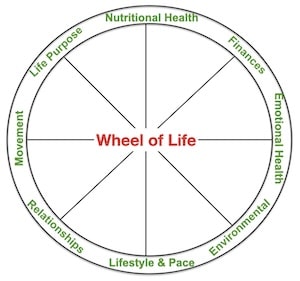 Wheel of Life health coaching is one way to see the whole person. Life coaching and health coaching use this tool, which typically consists of about eight key categories: the version I use, which I learned from the Chrysalis Effect training, focusses on: Nutritional Health, Finances, Emotional Health, Environment, Lifestyle & Pace, Relationships, Movement and Life Purpose.
My strength & conditioning colleague Paul Ehren, via his eloquently written article, has termed this thinking an athlete’s ‘ecosystem’, and research confirms that athletes’ food choices are shaped by a wide range of personal, social and environmental factors (Birkenhead & Slater, 2015). If we miss one crucial area in our client’s life it could mean the difference between successfully progressing them, or not. For example, did your client tell you that he was going through a divorce, or that times are financially tough and he can’t afford the organic vegetables that you’ve been insistent on him purchasing?
When the Mind Gets in the Way: Overtraining, Perfectionism and Ego in Sport
I’ve been speaking in a general way so far about understanding our clients, identifying challenges, and helping them to overcome these. But when we move into a sport-specific context, we will inevitably meet new challenges – in many cases our clients have too much motivation to succeed, and they come with very impressive goals. For example, I once worked with a busy lawyer in her 30s, who stated matter-of-factly in our first session that her goal was to win an international Ironman race. I think my jaw visibly dropped! The amazing thing was that she actually achieved this goal a couple of years later, but she did so via life simplicity, negotiating a part-time work arrangement, and working hard on her personalised nutritional health. I wrote up this case in Chapter 2 of the Integrative Sport and Exercise Nutrition textbook.
Not all our clients are so blessed with genetics, life simplicity and physiological adaptability though. I’ve negotiated several head-strong recreational athletes away from their next marathon, Ironman or multi-day mountain bike event, requesting rather than they take the next few months to get their health in check rather than physiologically depleting themselves further, making it less likely they’ll even reach the start-line. With good health, there will always be another race and another year…
Goal setting for athletes: why ‘Realistic’ matters most
Goal setting is possibly the most extensively researched area when it comes to motivating behaviour change (Locke and Latham, 2002), but when goal setting for athletes, I believe that one letter matters more than the rest. Within the SMART goal setting framework, I pay special attention to the R. Yes, a well-formed goal needs to be specific, measurable, achievable and timed, but is it realistic? It might be theoretically achievable based on previous results, but if the athlete currently has an extremely high life load or is struggling with recurring illness or injury, for example, it’s your job, as their trusted guide, to tell them that it might not be realistic in this time and space.
Spotting overtraining, perfectionism and REDs
When working with mind-body awareness in a sport and exercise nutrition context, you’ll start noticing perfectionist traits (Hill et al., 2018), compulsive behaviour, and often overtraining (Meeusen et al., 2013). The training itself might not indicate overtraining to you, but when you consider their entire ecosystem, they may be over-pressuring themselves which will affect their ability to train, recover and adapt. Additionally, Relative Energy Deficiency in Sport (REDs), despite rising awareness, continues to be a common concern in athletes, recreational and elite alike (Mountjoy et al., 2023), although researchers debate the causative factors of the signs and symptoms typically associated with REDs (Jeukendrup et al., 2024). Read more on this topic by my colleague Simone do Carmo. [link Simone’s article]
Getting Into the Client’s Mind: Linking Goals to a Client’s Core Values
I’ve mentioned goal setting and the Wheel of Life as two powerful tools for mind-body support in sport and exercise nutrition consultations, and why I find them helpful. Another one I commonly work with is a values elicitation exercise.
You could describe core values as the guiding principles in a person’s life, shaping what they pay attention to, choose, and do (e.g. Schwartz, 2012). For a health practitioner, this means that a client’s behaviour is more likely to sustainably change when a goal is linked to a core value, rather than a goal that is imposed from outside (by family, friends, a coach, social media, etc). This is consistent with self-determination theory, which proposes that autonomously motivated behaviour is more likely to be sustained than behaviour driven by external pressure (Ryan and Deci, 2000).
 A values exercise in practice: the Masters cyclist
To give a client values example, I was working with a Masters cyclist who was suffering from recurrent periods of fatigue and immune compromise after heavy training blocks. His desire for athletic performance kept driving him into a likely overtraining situation, which was depleting him physiologically. However, when we undertook a values exercise, he placed ‘success’ only third on his list, with ‘health’ first. With this realisation, he established better life balance with health at the fore, and actually experienced better consistency of cycle training and performance because he was no longer constantly pushing himself beyond his adaptive capacity.
Calming the Mind to Support Performance: Mindfulness and Breathwork
I mentioned earlier the power of our unconscious mind, and how deeply embedded patterns can drive us to behaviours that deviate from true health and physical performance. In essence, working with these mind-body tools in sport and exercise nutrition consultations helps to bring decision making into consciousness. Another way of describing this is mindfulness, which is a mind-body technique itself.
Research has associated mindfulness with higher levels of physical activity in the general population, and with better performance plus lower competitive anxiety in athletes, although scientists recognise the quality of the evidence so far may be limited (Noetel et al., 2019; Schneider et al., 2019).
Mindfulness must be trained via daily practice, just like the physical body, and a very useful accompaniment is breathing or meditation, which can still the mind and allow the individual greater clarity of thought. That might help them connect them to the core values associated with their exercise or nutrition goal or it might help them to sense a tired body that needs gentle nourishing rather than pushing through another heavy training session.
Mind-Body Practice and Scope of Practice for Exercise and Nutrition Practitioners
Mindful communication with clients
 Just as mindfulness helps our clients connect to their core motivations for behaviour change, practitioners can achieve similar benefits by being mindful in their practice. Mindfully communicating with our clients can help us understand them better and potentially build greater empathy with them (Krasner et al., 2009), along with identifying the limiting beliefs they may raise when we talk to them. A limiting belief might be, for example, that they need to train fasted every day because they watched a persuasive influencer on social media who spoke of such strategies, even though in the context of your client, this may inhibit their own performance potential. Or it might be that they’ve succumbed to product marketing and are now consuming a very stimulating sports nutrition product that you can mindfully see may be lifting their energy during the session, but inhibiting their muscular growth and recovery potential afterwards.
Knowing your scope of practice
So we can learn to support our integrative sport and exercise nutrition clients’ mind-body health, but to a point. All of us have a limited scope of practice based on our original qualification(s), subsequent training, and personal and client experiences. As I’ve outlined above, there are many very useful mind-body exercises you can learn to support your clients with. But we must be aware that psychology is a complex subject matter and that we can only do so much. For example, a case of REDs, where you suspect an underlying eating disorder, would be an obvious time to refer your client to a practitioner more skilled in this area.
Adverse childhood experiences
Many athletes have also experienced ACEs (Adverse Childhood Experiences), which may have spurred them on to the successes they’ve had (Hardy et al., 2017). But this is always a double-edged sword. I, for one, was subjected to bullying at school as a 10-year old, which stopped when I started running because of my rising confidence levels from winning races. This led to me chasing a 20-year Olympic dream, which never happened, perhaps in part due to recurrent overuse injuries, as I too often slipped to the other side of that sword!
So, with respect and empathy, get to know your clients – really get to know them. They each have a fascinating story to tell and they each have deeply embedded psychology to explore. When illuminated, some aspects of their psychology will drive them and motivate them towards their (well formed) goals, whereas other aspects will constantly try to trip them up. You can help them to understand their ‘self’ with some simple mindful practices, but always be mindful of your limitations, knowing when to share your valuable client with another trusted practitioner who can progress them on in different ways.
Key takeaways
Lasting behaviour change in nutrition and exercise depends on understanding the client’s mind as well as their stated desires. Goals that link to a client’s core values, rather than to external pressure, are far more likely to stick, and tools like the Well Formed Outcome, the Wheel of Life and a values exercise may help to uncover them. Remember to look at the whole ecosystem of a client’s life, be especially realistic with athletes who are highly driven, and watch for signs of overtraining, perfectionism and REDs. Mindfulness and breathwork can bring unconscious patterns into awareness, but always know your scope of practice and when to refer a client on.
Learn more with CISN
It is vital for practitioners to be able to stimulate behaviour change in nutrition and exercise with their active clients. In order to achieve this, learning mind-body approaches, including tools such as goal setting, values and mindfulness may transform your practice.
This is why we created A Mind-Body Perspective in Sport, a 4-week immersive module that can be studied for professional development (CPD/CEU) with a live cohort or via self-paced learning. In it you will learn all the mind-body exercises described in this article plus many others.
FAQs
Why does nutrition advice alone often fail to change behaviour?
Because habits, automatic associations and the people around us drive much of what we do, so information is often outweighed by unconscious patterns.
What is the ‘cliff edge’ analogy for readiness to change?
It describes clients at different distances from taking action: some need only a small push, while others need deeper mind-body support before they can jump.
What is a Well Formed Outcome?
It is a goal-setting technique that takes more time to align a client’s goal with their core values, rather than simply agreeing a quick target.
How do core values help clients stick to their goals?
Goals linked to a person’s own values feel autonomous rather than imposed, which makes them more likely to be sustained.
What is the Wheel of Life in health coaching?
It is a tool covering about eight life categories, such as nutritional health, finances and relationships, that helps practitioners see the whole person.
Why does the “R” in SMART goals matter most for athletes?
A goal may be achievable on paper but unrealistic given a client’s current life load, illness or injury.
How can practitioners spot overtraining and perfectionism in clients?
By looking beyond the training itself to the client’s whole ecosystem, noticing compulsive behaviour and over-pressuring that may affect recovery and adaptation.
Can mindfulness and breathwork support sport and exercise nutrition?
Yes, they can help clients make conscious decisions and tune in to their body’s needs, although the quality of the research evidence is still limited.
When should a practitioner refer a client to another professional?
When a case moves beyond your training; for example if you suspect an underlying eating disorder alongside REDs.
How can practitioners use mindful communication with clients?
It helps you understand clients better, build empathy and identify limiting beliefs, such as feeling they must train fasted every day because of social media advice.
 Ian Craig MSc DipCNE FBANT INLPTA is the founder of the Centre for Integrative Sports Nutrition (CISN) and course leader of their online postgraduate level courses. He is an experienced exercise physiologist, nutritional therapist, NLP practitioner, and an endurance coach. Clinically, within a team dynamic, Ian works with sporting individuals and complex health cases at his Scottish home, and online. Additionally, Ian co-authored the Struik Lifestyle book Wholesome Nutrition with his natural chef wife Rachel Jesson, and the Routledge textbook Integrative Sport and Exercise Nutrition with Professor Justin Roberts.
LinkedIn: ian-craig-nutrition/
- Birkenhead KL and Slater G (2015). A Review of Factors Influencing Athletes’ Food Choices. Sports Med. 45(11):1511-1522.
- Duffy KA et al. (2020). Mimicry and modeling of health(-risk) behaviors: How others impact our health(-risk) behaviors without our awareness. Journal of Nonverbal Behavior. 44(1), 5-40.
- Hardy L et al. (2017). Great British medalists: Psychosocial biographies of Super-Elite and Elite athletes from Olympic sports. Prog Brain Res. 232:1-119.
- Hill AP et al. (2018). Multidimensional perfectionism in sport: a meta-analytical review. Sport, Exercise, and Performance Psychology. 7(3):235-270.
- Jeukendrup A et al. (2024). Does Relative Energy Deficiency in Sport (REDs) Syndrome Exist? Sports Med. 54(11):2793-2816.
- Krasner MS et al. (2009). Association of an Educational Program in Mindful Communication With Burnout, Empathy, and Attitudes Among Primary Care Physicians. JAMA. 302(12):1284-1293.
- Locke EA and Latham GP (2002). Building a practically useful theory of goal setting and task motivation. A 35-year odyssey. Am Psychol. 57(9):705-717.
- Meeusen R et al. (2013). European College of Sport Science; American College of Sports Medicine. Prevention, diagnosis, and treatment of the overtraining syndrome: joint consensus statement of the European College of Sport Science and the American College of Sports Medicine. Med Sci Sports Exerc. 45(1):186-205.
- Mountjoy M et al. (2023). 2023 International Olympic Committee’s (IOC) consensus statement on Relative Energy Deficiency in Sport (REDs). Br J Sports Med. 57(17):1073-1097.
- Noetel M et al. (2019). Mindfulness and acceptance approaches to sporting performance enhancement: A systematic review. International Review of Sport and Exercise Psychology. 12(1):139-175.
- Rebar AL et al. (2016). A systematic review of the effects of non-conscious regulatory processes in physical activity. Health Psychology Review. 10(4):395-407.
- Ryan RM and Deci EL (2000). Self-determination theory and the facilitation of intrinsic motivation, social development, and well-being. Am Psychol. 55(1):68-78.
- Schneider J et al. (2019). The role of mindfulness in physical activity: A systematic review. Obesity Reviews. 20(3):448-463.
- Schwartz SH (2012). An overview of the Schwartz theory of basic values. Online Readings in Psychology and Culture. 2(1).